
Lisbon is one of the most beautiful cities in the world. It's also one of the most misunderstood. This guide tells you what a lot of visitors get wrong — and what you absolutely cannot miss.

Lisbon (Lisboa to the Portuguese) is the westernmost capital city in continental Europe. It sits on seven hills above the Tagus River, about 15 kilometres from where the river meets the Atlantic. It's a UNESCO-protected old town, a thriving expat hub, an extraordinary food city, and one of the best family travel destinations in Europe — all at the same time.
We live in Portugal and spend a lot of time in Lisbon. This blog article reflects what we actually think.
Our ideal itinerary and personal favorites in the city?
If you'd rather skip the research and jump straight into an expertly planned trip, we've done the work for you. Our 5-Day Lisbon Itinerary eGuide gives you a complete day-by-day plan: where to go, in what order, which neighbourhoods to pair together, the best restaurants for each area, how to get around without wasting time, and all the insider tips we've picked up from living in Portugal. No more agonising over what to prioritise or how to structure your days — it's all mapped out.
A City Built on Seven Hills (and One Earthquake)
Before you arrive, here's the history that makes Lisbon make sense.
The city has been inhabited since at least 1200 BCE — Phoenicians first, then Greeks, then Carthaginians, then Romans. The Romans built a settlement called Felicitas Julia here and it became one of the most important cities on the Iberian Peninsula. The Moors conquered in the 8th century and named the neighbourhood they settled in al-hamma — "hot springs" — which became Alfama, still the oldest surviving neighbourhood in the city today.
In 1147, a group of Crusaders on their way to the Holy Land helped the Portuguese King Afonso Henriques retake Lisbon from the Moors — the city became the capital of Portugal in 1255. Over the next three centuries, Lisbon grew into one of the wealthiest and most powerful cities in the world, the jumping-off point for Portugal's Age of Discovery and the trade routes that connected Europe to Africa, Asia, and the Americas.
Then, on the morning of 1 November 1755 — All Saints' Day, when most of the city was in church — one of history's deadliest earthquakes struck. The initial tremors, the subsequent tsunami, and the fires that burned for five days destroyed approximately 85% of Lisbon. An estimated 30,000-40,000 people died.
The city's reconstruction was led by the Marquis of Pombal, the king's chief minister. He designed the Baixa district — the neat, rational grid of streets you still walk today — as a new city centre, built on enlightenment principles to be earthquake-resistant. The black and white mosaic pavements (calçada portuguesa) that cover Lisbon's streets and squares are part of this rebuilding legacy.
The only neighbourhood that survived relatively intact was Alfama, built on bedrock rather than alluvial soil. Walking Alfama today is, in a very real sense, walking through a city that escaped the catastrophe that reshaped everything around it.

The Neighbourhoods Worth Knowing
Alfama is Lisbon's oldest and most atmospheric neighbourhood — a maze of steep cobblestone streets and staircases climbing the hill below São Jorge Castle, draped in bougainvillea and azulejo tiles, with Fado music drifting from restaurants and the bells of the Sé Cathedral marking the hours. It's beautiful, it's authentic, and it rewards slow wandering over any kind of planned itinerary. Just wear shoes with grip — the tiles are stunning and genuinely slippery.
Mouraria, just below the castle and adjacent to Alfama, is historically the Moorish quarter and widely considered the true birthplace of Fado. It's one of Lisbon's most multicultural neighbourhoods today — filled with small restaurants, street art, and a lived-in energy that feels a world away from the tourist-heavy streets nearby. Explore it in the morning when it's quietest.
Belém, slightly west of the centre along the Tagus, is where the Age of Discovery monuments are concentrated — the Tower of Belém, the Monument to the Discoveries, the Jerónimos Monastery. It's also where the original Pastéis de Belém bakery has been making custard tarts to a secret recipe since 1837. We'll tell you our honest take on the monastery in a moment.
Baixa and Chiado are the commercial heart of Lisbon — the Pombaline grid, the grand Praça do Comércio opening to the Tagus, the elegant Rua Augusta pedestrian street, and the hilltop Bairro Alto and Chiado neighbourhoods rising above. This is the Lisbon of beautiful squares, independent bookshops, and some of the city's best restaurants.
LX Factory is a converted 19th-century industrial complex in Alcântara that's been transformed into a creative hub of restaurants, bars, concept stores, and studios. The Sunday market (Feira da LX) is one of the best in Portugal — vintage finds, street food, live music, and a relaxed atmosphere that local families love.
Príncipe Real is Lisbon's most elegant neighbourhood — wide streets lined with grand 19th-century mansions, one of the city's best weekend markets (the organic Mercado de Príncipe Real), excellent restaurants, and the beautiful Jardim do Príncipe Real anchoring the whole thing.
The Absolute Must-Dos
A Boat Ride on the Tagus — Non-Negotiable
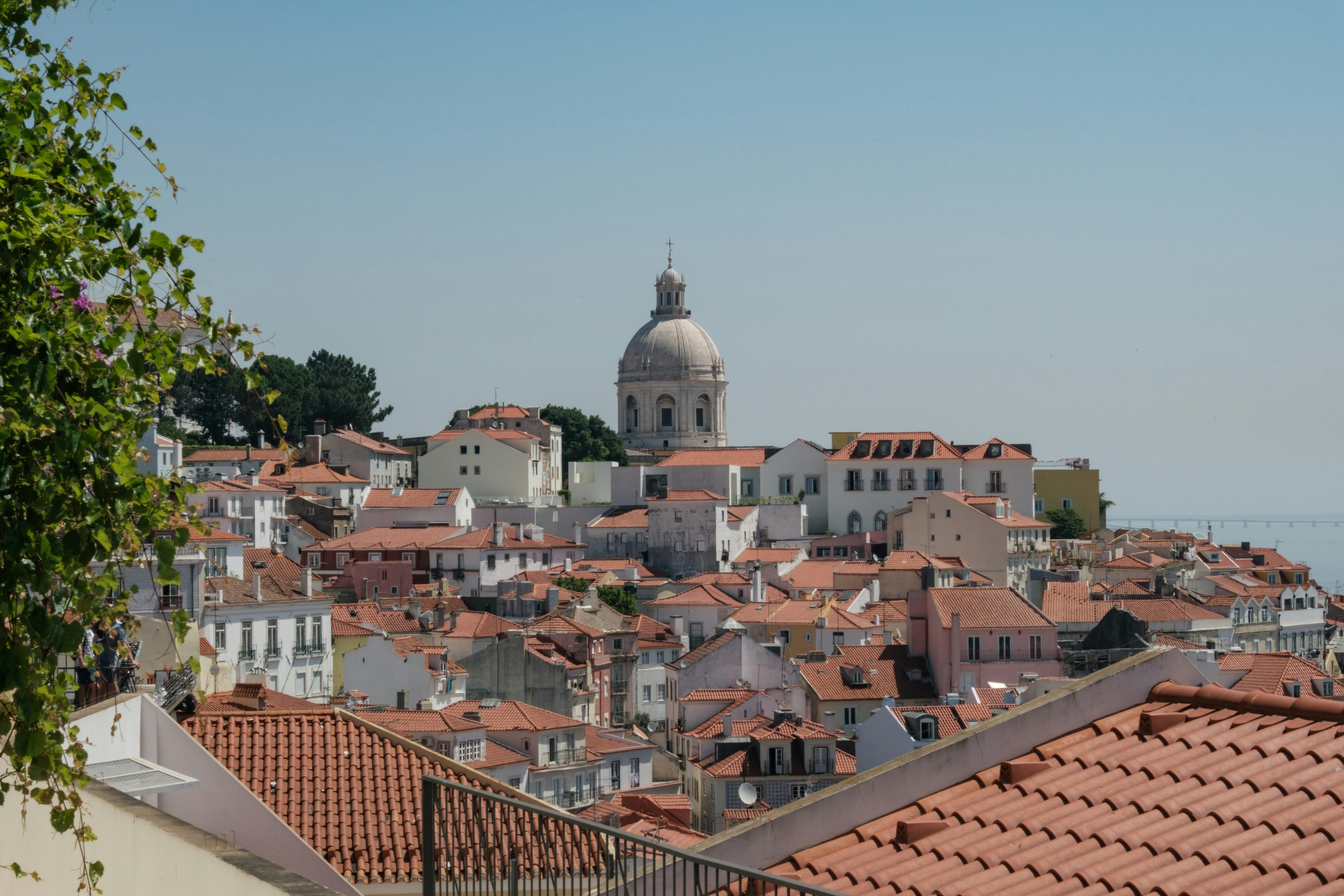
If you do nothing else in Lisbon, do this. A boat ride on the Tagus River gives you a perspective on the city you simply cannot get from the hills — the full sweep of the waterfront, the bridge, the Alfama skyline, the way the city climbs upward from the river in layers of terracotta and white. It's one of those experiences that makes the photographs make sense.
Various boat trips depart from the Praça do Comércio waterfront — from short scenic cruises to sunset sailings. For a truly local experience, you can also take the regular ferry to Cacilhas on the south bank (just a few euros and a few minutes), and look back at Lisbon from the water. However you do it, get on the river.

A Fado Dinner — Equally Non-Negotiable
Fado is the soul of Lisbon, and experiencing it live over dinner in Alfama or Mouraria is one of the great travel experiences in Europe — genuinely moving even if you don't speak a word of Portuguese. The word "fado" comes from the Latin for fate, and the music reflects that: it's a style about longing, loss, the sea, and the particular Portuguese feeling of saudade — a melancholic nostalgia for things you may never have had.
UNESCO declared Fado an Intangible Cultural Heritage of Humanity in 2011. It originated in the early 19th century in the taverns of Alfama and Mouraria among sailors and the working poor, which is why it carries such emotional weight.
Book a fado dinner in advance — the best casas de fado fill up weeks ahead. Tasca do Chico and Clube de Fado in Alfama are both excellent. The combination of good food, live Fado, and a carafe of house wine on a warm Lisbon night is one of those memories you carry for the rest of your life.
São Jorge Castle
The medieval castle on Lisbon's highest hill has been there, in various forms, since at least the 1st century BCE. The current Moorish fortifications date to the 11th century and the views from the towers — looking over the entire city, the Tagus, and on a clear day all the way to the sea — are exceptional. Allow a couple of hours and go early to beat the queues.
Pastéis de Belém
The original custard tart bakery has been operating since 1837, guarding their recipe under lock and key. The tarts here — warm, slightly caramelised, with a shattering pastry shell — are different from every other pastel de nata you'll eat in Portugal, and the difference is worth making the journey to Belém for. Get there before 10am to avoid the longest queues.

The Viewpoints: Where to Actually Go
Lisbon's seven hills mean spectacular viewpoints (miradouros) at almost every turn. Here are the two we'd specifically send you to:
Miradouro da Senhora do Monte is our personal favourite and the highest miradouro in the city. The view encompasses the full spread of Lisbon — the castle, Alfama, the Baixa, the river, and Belém in the distance. It's slightly harder to reach than some of the other viewpoints (there's a climb involved), which means it's less crowded, and it has a small chapel that adds to the atmosphere. Go at sunset. You'll understand immediately.
Miradouro de Santa Catarina has a completely different energy — this is where Lisbon's young, creative crowd gathers with guitar players and cold beers to watch the sunset over the river and the 25 de Abril Bridge. The atmosphere is infectious and the view is genuinely spectacular. The large Adamastor statue presides over the whole thing.
Important caveat for Santa Catarina: this miradouro is well-known for pickpockets. Keep your phone in your pocket, don't leave bags unattended, and be aware of who's around you — particularly if a group creates a distraction. Once you're alert to it, you'll enjoy the atmosphere without any trouble.
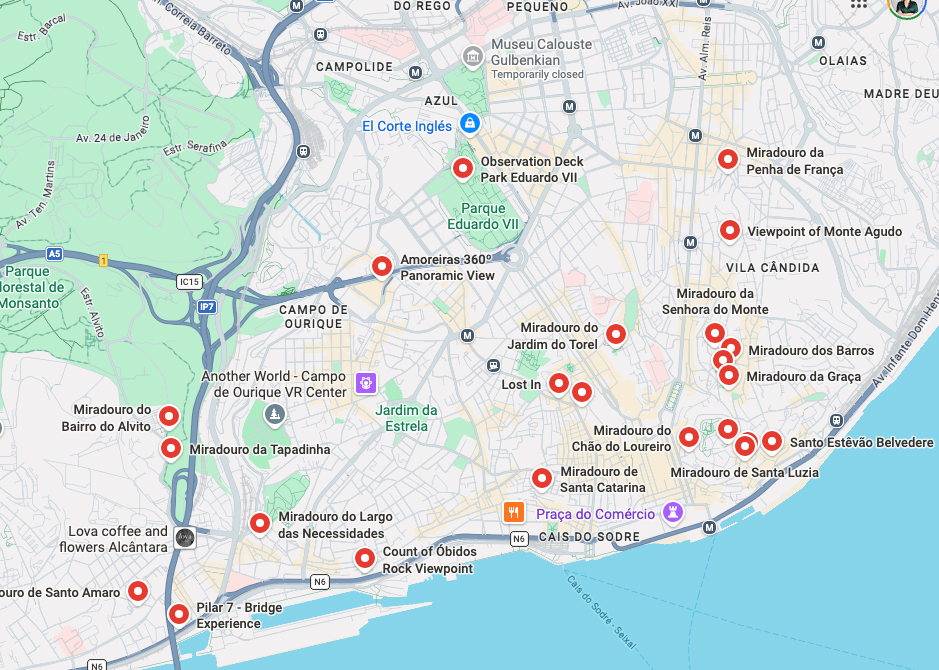
Other excellent miradouros: Miradouro da Graça (quieter, equally beautiful views), Miradouro de São Pedro de Alcântara (more formal, garden-style, great over the Baixa).
Josien made a Google Maps list with all look out points in Lisbon that are worth visiting, you can find it here: https://maps.app.goo.gl/otYjTYeBM85qA8XL8
Our Honest Takes: What's Overhyped and What to Skip
Mosteiro dos Jerónimos — Beautiful, But Know What You're Getting
Every Lisbon guide tells you the Jerónimos Monastery is a must-see. And it is, genuinely, a masterpiece of Manueline architecture — the ornate carved stonework, the double cloister, the extraordinary detail on every surface. It took over a century to build and it shows.
But here's our honest take: if architecture is your thing, absolutely go — it's magnificent. If you're traveling with young children, or you're visiting in peak summer and the queues are 45 minutes long in the heat, or you're not particularly moved by 16th-century ecclesiastical Manueline Gothic, then the time might be better spent elsewhere. Know what you're choosing and go in with the right expectations.
Tram 28 — Skip the Queue, Take a Different Tram
Tram 28 is one of Lisbon's most photographed attractions — the iconic yellow tram grinding through the narrow streets of Alfama and Graça. And it is beautiful. It also frequently has queues of 30-45 minutes, runs packed with tourists rather than locals, and has a well-documented pickpocket problem.
Our honest advice: admire Tram 28 from the street for the photograph, then use the metro, a bus, or walk. The city is more rewarding on foot anyway. If you want an authentic tram experience that actually moves through the city with locals, Tram 28E (a different route) is far more manageable.

Airport Taxis — The Biggest Tourist Trap in Lisbon
This one we can't stress enough. Do not take a taxi from Humberto Delgado Airport into Lisbon. Airport taxis have a long history of overcharging tourists — adding luggage fees, "airport surcharges," and taking longer routes. The metro is faster, cheaper, more reliable, and runs directly from the airport to the city centre in about 20 minutes.
Take the Red Line from the airport to Oriente or Alameda, change to your preferred line, and you're done. Bolt and Uber are also reliable and transparent alternatives if you have a lot of luggage. We cover both of these tourist traps in our video:
The Museums of Lisbon
Lisbon punches well above its weight on museums, and this is an area most travel guides underserve. Here are the ones genuinely worth your time:
Museu Nacional do Azulejo is one of the most underrated museums in Europe — a former convent turned entirely into a museum dedicated to the history and art of the azulejo tile, from simple geometric patterns to complex panoramic scenes. It's housed in a beautiful 16th-century building, and the museum itself is as beautiful as its exhibits. Don't miss the 18th-century panoramic tile panel showing Lisbon before the 1755 earthquake — a haunting and extraordinary object.
MAAT (Museum of Art, Architecture and Technology) is Lisbon's most architecturally striking modern museum, with a walkable curved roof that gives one of the city's best views of the Tagus. Its contemporary art exhibitions are consistently interesting, and it sits next to a restored power station (the Museu da Electricidade) that you can also explore.
Museu Nacional de Arte Antiga is Portugal's national art museum and criminally overlooked. The collection spans Portuguese painting from the 15th-16th centuries (including Nuno Gonçalves' extraordinary Panels of Saint Vincent), alongside Asian and African objects collected during the Age of Discovery. World-class, rarely crowded.
Museu Coleção Berardo in Belém houses one of Europe's finest private collections of modern and contemporary art — Warhol, Picasso, Dalí, Duchamp, Bacon, Pollock. Free on Saturdays, which makes it one of the best free things to do in the city.
Pavilhão do Conhecimento (Pavilion of Knowledge) in Parque das Nações is Lisbon's science museum and is specifically excellent for children — hands-on exhibits, a robot programming station, physics experiments, and an entire section dedicated to mathematics. It's interactive in the best possible way.

Food & Drink in Lisbon
Pastéis de nata we've already discussed, but they deserve a second mention: get them warm, with cinnamon, alongside a bica (espresso). This is the definitive Lisbon breakfast and it costs about €1.50.
Ginjinha is the local cherry liqueur — available at tiny ginjinha bars throughout the Rossio area for about €1.50 a shot. Try it at A Ginjinha on Largo de São Domingos, one of the oldest in the city.
Grilled sardines (sardinhas assadas) are the essential summer dish — June is the peak month, when the city smells of charcoal and sardines during the Festas de Lisboa. Order them with bread and a green salad, eat them with your hands, and don't worry about being neat.
Bacalhau (salt cod) is Portugal's national obsession — there are said to be 365 different ways to cook it, one for every day of the year. Bacalhau à Brás (shredded cod with eggs and thin potato strings) and Bacalhau com natas (cod with cream) are the most commonly loved versions.
Carne de porco à Alentejana — pork with clams, cooked together in a cataplana (copper pot) — sounds like an unlikely combination and tastes extraordinary. Don't overthink it.
For tips on eating well on a budget and getting the most from Lisbon's food scene, our 101 Portugal Travel Tips covers everything from lunchtime prato do dia deals to which bread on the table is free and which will appear on your bill.
Lisbon with Kids: What Actually Works
Lisbon is wonderful with children — genuinely, not just in the "all Portuguese people love children" sense (though that's also true). The variety of experiences, the outdoor spaces, and the city's manageable scale make it extremely family-friendly. Here's what we specifically recommend:
Oceanário de Lisboa is world-class. Consistently rated one of the best aquariums in Europe, it's home to the only sea otters on the European mainland, sharks, manta rays, thousands of fish species, and four different ocean habitats — all displayed in a stunning central tank the size of a building. Plan 2-3 hours, book tickets online in advance, and go on a weekday morning. It's in Parque das Nações in the east of the city.
The Cable Car (Telecabine Lisboa) runs along the Tagus waterfront in Parque das Nações — a gentle 8-minute gondola ride above the river with views of the Vasco da Gama Bridge. It's short, it's beautiful, and children love it unreservedly. Combine it with the Oceanário for a perfect family day in the eastern waterfront.
The Tram Café is exactly what it sounds like — a vintage tram converted into a café. It's a genuinely charming, novel experience that kids (and adults) find delightful. Great for a mid-exploration coffee stop that doesn't feel like dragging the children into another grown-up café.
Estrela Park (Jardim da Estrela) is one of Lisbon's best parks and our favourite for families. The large playground is genuinely impressive — one of the best near the city centre — and the park itself has duck ponds, turtles, a lake, shaded paths, and a café that does weekend activities for children. It sits opposite the beautiful Basílica da Estrela and opens at 7am, making it perfect for early risers.
For a full guide to Lisbon's parks with playgrounds and kiosks, we've put together a dedicated resource at Lisbon Parks with Playground & Kiosk — everything you need to keep the family happy between sightseeing.
Day Trips from Lisbon
Lisbon's position on Portugal's west coast makes it one of the best bases in Europe for day trips.
Sintra (40 minutes by train from Rossio Station) is the most popular day trip — and rightly so. The palaces (Pena Palace, Quinta da Regaleira, the Castle of the Moors), the forest, and the fairytale atmosphere make it genuinely extraordinary. Go on a weekday and arrive early. Lord Byron called it "perhaps in every respect the most delightful place in Europe."
Cascais (40 minutes by train from Cais do Sodré) is a coastal resort town with beautiful beaches, a marina, excellent seafood restaurants, and a relaxed atmosphere. It's very easy with children and combines beautifully with a stop in Estoril.
Setúbal and Arrábida (about 1 hour by car) — the Arrábida Natural Park has some of the most beautiful beaches in mainland Portugal, with turquoise water and limestone cliffs that seem more Mediterranean than Atlantic. Go by car.
Plan Your Trip: Our 5-Day Lisbon Itinerary
If you'd rather skip the research and jump straight into an expertly planned trip, we've done the work for you. Our 5-Day Lisbon Itinerary eGuide gives you a complete day-by-day plan: where to go, in what order, which neighbourhoods to pair together, the best restaurants for each area, how to get around without wasting time, and all the insider tips we've picked up from living in Portugal. No more agonising over what to prioritise or how to structure your days — it's all mapped out.

Best Time to Visit Lisbon
Spring (March–May) is our favourite time. The city is warm, the flowers are out, the light is extraordinary, and the crowds haven't arrived yet. April in particular is magical — temperatures around 18–22°C, very little rain, and a city that feels genuinely alive without being overwhelming.
Summer (June–August) is busy and hot — up to 35°C in July and August, which can be fierce in the city's hills. June is our favourite summer month: the Festas de Lisboa (including Festa de Santo António on June 12-13) fill the streets with grilled sardines, music, and celebrations that are genuinely joyful and family-friendly.
Autumn (September–October) is warm, settled, and significantly less crowded than summer. September in Lisbon is one of Europe's great weather secrets — 25°C, golden light, and the city returning to its own rhythm.
Winter (November–February) is the quiet season — some rain, cooler temperatures (10–15°C), but far warmer than northern Europe and with a real local character that peak-season visitors never see. Prices are lower, queues are shorter, and Lisbon in the winter light is beautiful.
Getting There & Getting Around
Airport: Humberto Delgado Airport (LIS) sits just 7km from the city centre — one of the most conveniently located airports in Europe.
From the airport: Take the Red Line metro (direction São Sebastião or Rato, depending on where you're staying). It takes 20-30 minutes to the centre and costs around €1.65. Do not take a taxi — see our tourist trap warning above. Uber and Bolt are legitimate alternatives if you have significant luggage.
Getting around the city: The metro (4 lines, 56 stations) is fast, clean, and easy to navigate in English. Buses cover everything the metro doesn't. Walking is the best way to explore the historic neighbourhoods — just wear good shoes and accept that hills are part of the experience. Uber and Bolt are cheap and reliable for when your legs give out.
Useful card: The Viva Viagem card (€0.50 for the card + loadable credit) works on the metro, buses, trams, and even the Sintra and Cascais train lines. Get one at any metro station on arrival.
Thinking About Moving to Lisbon?
Lisbon has become one of the most popular cities in Europe for expats, digital nomads, and families looking to relocate — and with good reason. The quality of life is genuinely exceptional, the cost of living (while rising) is still significantly lower than comparable Western European capitals, the weather is outstanding, and the city is remarkably well-organised and safe.
If you're considering a move, understanding Portugal's visa options is the critical first step. We've put together a comprehensive breakdown of all Portugal D-type visa options — the passive income visa, digital nomad visa, job-seeker visa, and more — with a clear spreadsheet to match your situation to the right route.
7 Fun Facts About Lisbon
Frequently Asked Questions About Lisbon
- Lisbon is the westernmost capital city in continental Europe — it sits closer to New York City than it does to Warsaw.
- It's built on exactly seven hills (sete colinas), which is why the viewpoints (miradouros) are so central to Lisbon life — you're always either climbing to one or recovering from the descent.
- The 1755 earthquake destroyed 85% of the city — and was so powerful it was felt as far away as Finland. The tsunami it triggered reached the coast of Brazil. It was one of history's deadliest natural disasters.
- The calçada portuguesa — the black and white mosaic pavement covering Lisbon's squares and streets — originated here and is now protected as national heritage. It's made by hand, by artisans who still train for years to master the craft.
- Fado was declared UNESCO Intangible Cultural Heritage in 2011 — the same year as Flamenco and the Mediterranean diet. It originated in early 19th-century Lisbon taverns among sailors and the working class, and it's never really left them.
- Lisbon hosted the 1998 World Exposition (EXPO 98), themed around the ocean. The entire eastern waterfront — now Parque das Nações, home to the Oceanário and the cable car — was a derelict industrial site before EXPO transformed it.
- The 25 de Abril Bridge was built by the same company that built the Golden Gate Bridge in San Francisco, which is why they look remarkably similar from certain angles. It was completed in 1966 and was named after the date of Portugal's 1974 Carnation Revolution that ended 48 years of authoritarian rule.
Frequently Asked Questions About Lisbon
What is Lisbon known for?
Lisbon is known for its Fado music (UNESCO Intangible Cultural Heritage), its azulejo ceramic tiles, the Age of Discovery monuments in Belém, its hilltop viewpoints (miradouros), São Jorge Castle, the atmospheric neighbourhood of Alfama, and its extraordinary food — particularly pastéis de nata (custard tarts) and grilled sardines.
How many days do you need in Lisbon?
Three days covers the essential highlights. Four to five days lets you add a day trip to Sintra or Cascais and explore the city at a more relaxed pace. If you want a complete day-by-day plan with the best routes, restaurant picks, and insider tips all mapped out, we've put together a 5-Day Lisbon Itinerary eGuide that takes the guesswork out of every day.
Is Lisbon good for families?
Excellent. The Oceanário, Estrela Park, the cable car, Parque das Nações, and the general warmth of Portuguese culture toward children make Lisbon one of the best family cities in Europe. The hills and cobblestones can be challenging with pushchairs — plan routes carefully and use Uber for the steeper sections.
Is Tram 28 worth it?
Honestly — not usually. The queues are long, it's crowded with tourists, and pickpockets work the route. Take the metro or walk instead. You'll see more and enjoy it more. Photograph the tram from the street by all means — it's genuinely beautiful — but don't queue for 45 minutes to ride it.
What's the biggest tourist trap in Lisbon?
Taxis from the airport. Always take the metro (Red Line) or use Uber/Bolt instead. Airport taxis have a long history of overcharging, and the metro is genuinely faster and easier.
What is the best viewpoint in Lisbon?
Our personal favourite is Miradouro da Senhora do Monte — the highest in the city, with the most complete panoramic view and fewer crowds than the more accessible viewpoints. Miradouro de Santa Catarina is excellent for atmosphere (live music, sunset, young local crowd) but be aware of pickpockets there.
What should I eat in Lisbon?
Pastel de nata (warm, with cinnamon), grilled sardines in June, ginjinha (cherry liqueur, €1.50 a shot near Rossio), bacalhau à Brás, carne de porco à Alentejana. And whatever the prato do dia (daily special) is at whichever local restaurant you wander into at lunchtime — it will almost certainly be excellent.
Is Lisbon safe?
Very. Violent crime is extremely rare. Petty theft and pickpocketing are the main concerns, particularly around Tram 28, in Alfama, and at busy miradouros. Keep valuables secure, be aware at crowded viewpoints (especially Santa Catarina), and you'll have no trouble.
When is the best time to visit Lisbon?
Spring (April–May) for ideal weather and manageable crowds. June for the Festas de Lisboa celebrations. Autumn (September–October) for warm weather and a return to local rhythms. All of these are better than peak summer (July–August) unless beach days are your priority.
Lisbon has been captivating visitors for centuries — Phoenician traders, Roman administrators, Moorish scholars, Crusader knights, Age of Discovery explorers, and now millions of travelers who arrive and immediately start looking for reasons to stay.
It earns that reaction every time.
Come for the custard tarts. Stay for everything else.